

The Biggest Door in Your House Is the One Nobody Locks
Most Richardson homeowners lock the front door without thinking, check it twice when they travel, and then walk past the largest entry point in the house without a second thought. Your garage door is a wide opening into the home, and behind it sits a car, tools, bikes, lawn equipment, and in most houses an interior door that leads straight into the kitchen or mudroom. For many families the garage is the door they actually use every day, which makes it the door a thief studies first.
At Garage Door Pros, we talk about springs, openers, and seals all day, but security comes up more than most people expect, usually right after a neighbor has a break-in. The good news is that garage security is not expensive or complicated. Almost every weak point has a simple fix, and most of them can be handled in a single visit. This guide walks through how thieves actually target garages, the four weak points we see again and again in Richardson homes, and the fixes that close each one.
How Thieves Actually Target a Garage
A burglar wants three things: speed, quiet, and privacy. A garage door offers all three when it is left in its factory state. Thieves are not usually picking locks or smashing panels. In general terms, the common approaches are fishing for the emergency release cord through the small gap at the top of the door, copying or guessing the signal of an old fixed code opener, walking in through a flimsy side door, peeking through the door windows to see what is stored inside and whether the car is gone, or simply finding the door standing open because it was left up by accident or bounced back up on its own.
None of these require strength or special skill, which is exactly why they work. They also share one weakness: each one fails the moment a homeowner closes the specific gap it depends on. That is the pattern running through everything below. You do not need to turn your garage into a vault. You need to remove the easy options, one at a time.
Weak Point One: The Emergency Release Cord
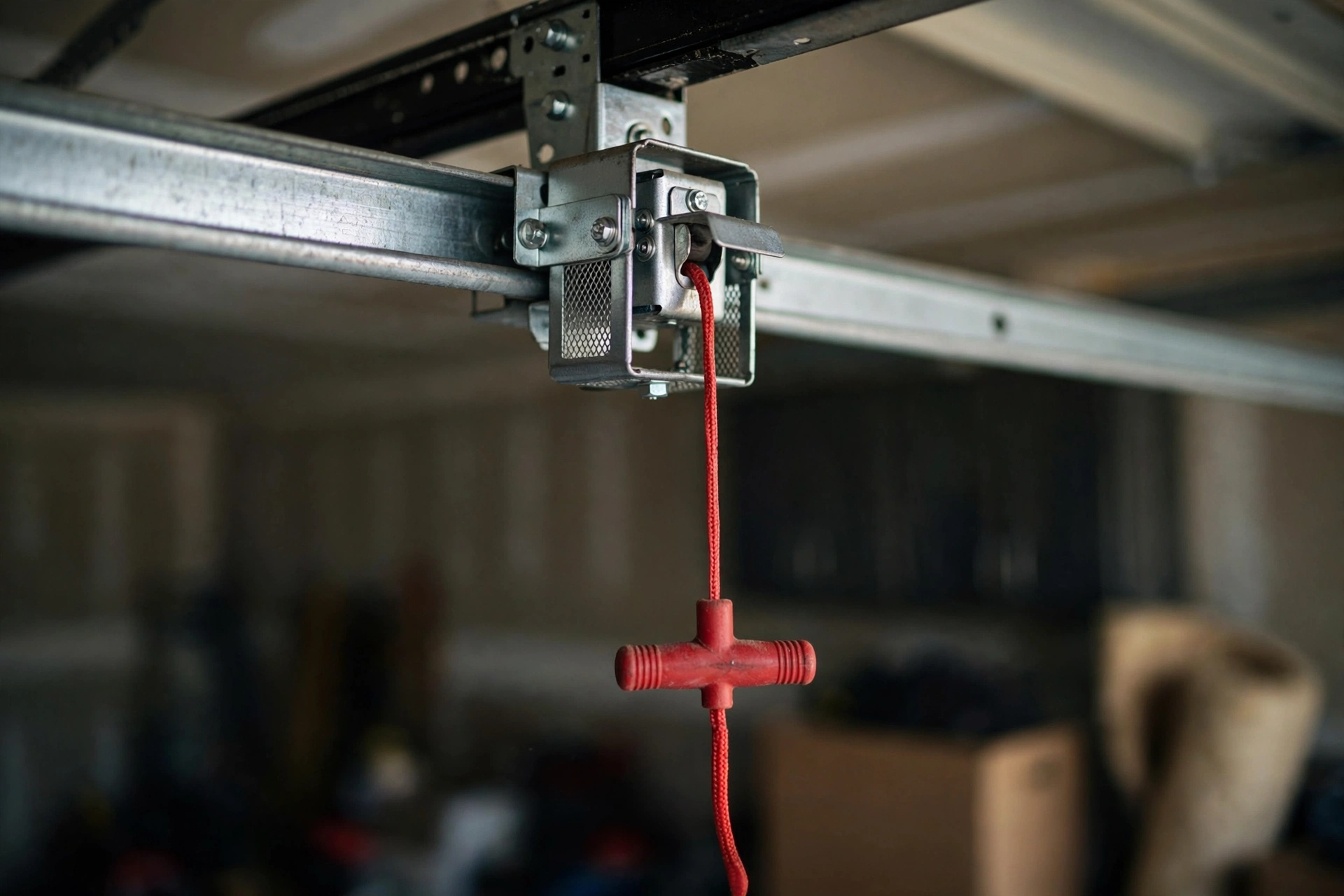
Every automatic garage door has an emergency release, usually a red handle on a cord hanging from the opener rail. Pull it, and the door disconnects from the opener so you can lift it by hand. That release is a safety feature, not a design flaw. It is how you get out during a power outage or a fire, and it must stay fitted and reachable. Never remove it, tape it off, or tie it up out of reach to stop thieves. That trades a break-in risk for a far more serious safety risk.
The problem is the gap at the top of the door. On many doors a hooked wire slipped through that gap can catch the release cord and trip it from outside, after which the door can be lifted quietly by hand. Police departments have warned homeowners about this trick for years. The fix keeps the safety feature and removes the vulnerability: fit a release shield or guard, a simple cover that blocks anything reaching the cord from outside while leaving the handle free to pull from inside. It is an inexpensive part, it takes minutes to install, and it turns the best known garage trick into a dead end.
Weak Point Two: An Opener Still Running a Fixed Code
If your opener is old enough, it may still open your door with a fixed code, a single signal set by tiny switches that never changes. Every press of the remote sends the same code, which makes it far easier to copy than a modern signal, and the number of possible combinations on the oldest units is small enough to work through. Openers built from the late 1990s onward use rolling code technology instead. The code changes with every single use, so a captured signal is worthless the next time.
This is why an opener upgrade is the biggest single security step most Richardson homes can take. If your opener predates rolling codes, replacing it closes a hole that no lock on the door itself can cover. Two habits matter just as much. Change the keypad code when you move into a home, because you have no idea how many babysitters, contractors, and former owners still know the old one. And never leave a remote clipped to the visor of a car parked in the driveway. A broken car window turns that remote into a house key, so bring it inside or carry a small keychain remote instead.
Weak Point Three: Side Doors, Windows, and the Door Into the House
Thieves look for the weakest door, not the biggest one, and on many garages that is the pedestrian side door. It often carries a light latch lock in a soft frame, and it sits out of view. Treat it like a front door: a solid door, a proper deadbolt, and a reinforced strike plate with long screws that bite into the framing, not just the trim.
The windows in the top section of the door deserve the same attention. Clear glass lets anyone inventory your tools, spot the empty car space that says nobody is home, and see whether the release cord is within reach. Frosting the glass or fitting covers keeps the light and removes the view. Finally, look at the door between the garage and the house itself. Many are hollow, lightly locked, or simply left unlocked because they feel like an inside door. They are not. That door is the last line between a thief who got into the garage and everything you actually care about, so it should be solid, deadbolted, and locked every night.
Weak Point Four: A Door That Will Not Stay Shut
A door that closes, touches the floor, and then pops back open is more than an annoyance. A house whose garage door will not stay closed is a house that is effectively unlocked, and a crooked door sitting with a gap along the floor is barely better. If your door is doing this, our guide to a garage door that closes then reverses walks through the sensor and travel setting causes and what you can check yourself.
If the door cannot be secured tonight, treat it as urgent rather than adding it to a weekend list. Our emergency garage door repair team handles doors that will not close or latch, because a door stuck open is a security problem first and a repair problem second. In the meantime, keep the interior door into the house deadbolted and bring anything portable and valuable inside.
The Richardson Factor: Alley Garages Hide Everything
Richardson has a local wrinkle that national security advice rarely mentions. Many of the city’s older neighborhoods were built with rear entry garages that open onto an alley instead of the street. Streets have passing cars, porch lights, and neighbors at windows. Alleys have none of that. A thief working on an alley door in a neighborhood like Richardson Heights or Heights Park gets the privacy that a front facing door never allows, and extra time is what turns a quick attempt into a successful one.
That changes where your money does the most good. Motion activated lighting over an alley door matters far more than it does over a street facing one, because it removes the darkness the whole approach depends on. A shield on the release cord matters more too, since nobody will notice someone lingering at the door. And a door that closes fully, seals flat, and locks itself removes the need for anyone to see anything at all.
The Security Checklist: Fixes That Actually Work
Worked through in order, these are the upgrades and habits that close nearly every gap described above:
- Shield the emergency release. Fit a guard that blocks the cord from outside while keeping it usable from inside.
- Run a rolling code opener. Replace any fixed code opener, and change keypad codes when you move in or a remote goes missing.
- Add an automatic door lock. Modern locks slide a bolt into the door track every time it closes, so a closed door is a locked door even if the opener is defeated.
- Frost or cover the door windows. Keep the daylight, lose the view of your tools and your car.
- Deadbolt both other doors. The pedestrian side door and the interior door into the house get proper deadbolts, locked nightly.
- Light the door, especially the alley side. Motion activated fixtures remove the cover of darkness.
- Keep the door maintained. A door that sags, gaps, or bounces back open cannot protect anything. A preventative maintenance tune-up keeps it closing flat and sealing tight.
- Close it, every time. The most common way into a garage is no trick at all. It is a door left open after unloading the car.
Smart Openers: Knowing the Moment Your Door Opens
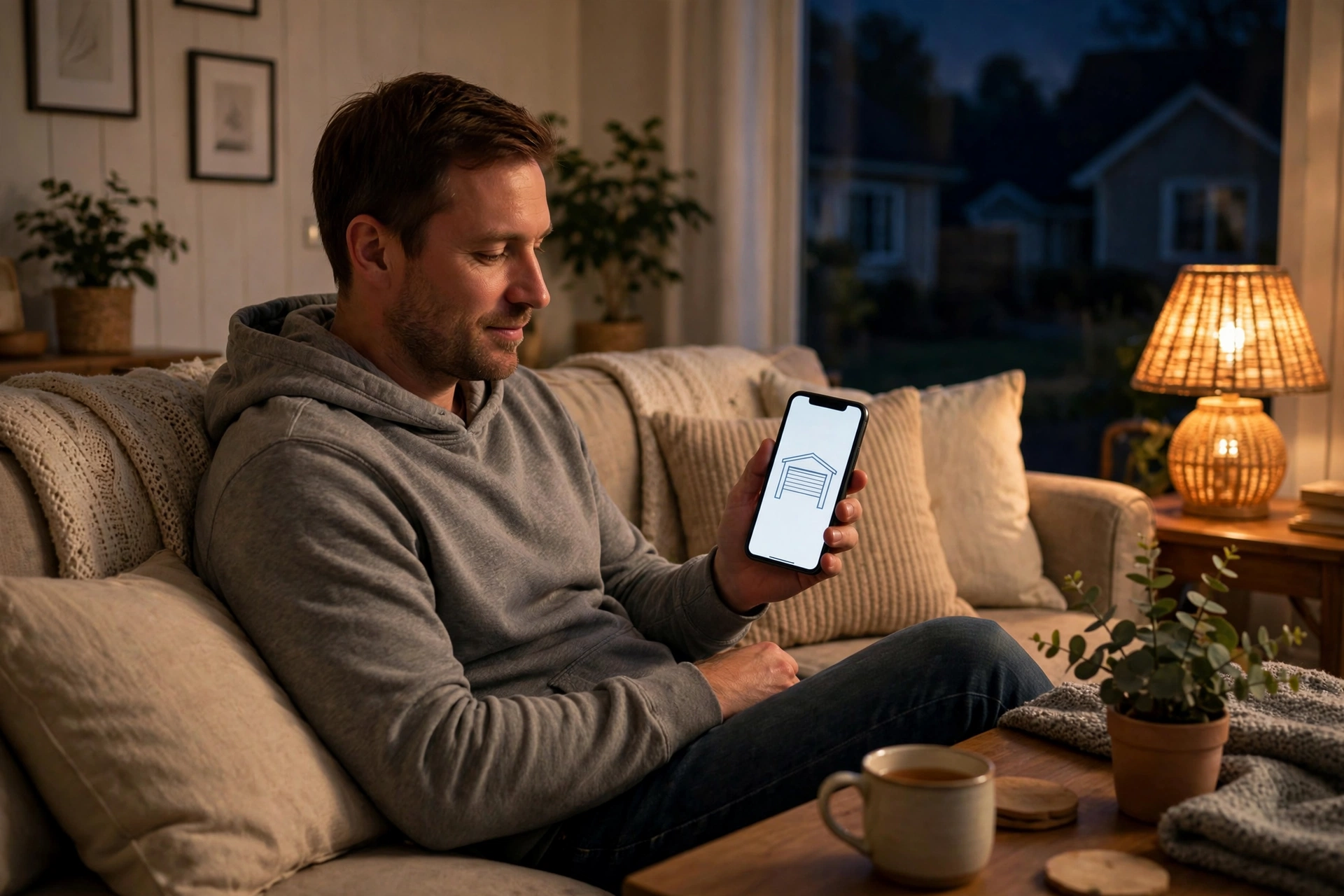
The newest layer of garage security is not a stronger door. It is information. A Wi-Fi connected smart opener sends a phone alert the moment your door opens or closes, warns you when it has been left open, and keeps a log you can check from anywhere. Many can also close the door automatically after a set time, which quietly fixes the most common security failure of all, the door somebody meant to close and forgot.
That changes the vacation question completely. Instead of wondering for two weeks whether the door went down, you can look at your phone, see it closed, and get an alert if that ever changes. Smart openers cannot fix a weak panel or a tired spring, and they do not replace the shield, the lock, and the lighting above. What they remove is the unknown. If your opener predates this technology, an upgrade visit can usually cover the opener itself, an automatic lock, and a release shield in one trip.
Leaving Town? The Ten-Minute Vacation Routine
Before a trip, run through this short routine so the garage looks after itself while you are gone:
- Lock the opener down. Switch on its vacation or lock mode if it has one, so remotes are ignored while you are away.
- Bring the remotes in. Take visor remotes out of any car staying in the driveway, and lock those cars.
- Check the manual lock. If your door has a slide lock on the inside, throw it for the trip, and make sure everyone at home knows it is set before the opener runs again.
- Test the lights. Walk the alley or driveway after dark and confirm the motion lights actually trigger.
- Lock every other door. Side door and interior house door, deadbolts both.
- Turn the alerts on. Open the opener app, confirm notifications are enabled, and check the door shows closed.
- Ask a neighbor. A quick word with someone on your street covers the things no device can see.
Frequently Asked Questions
What is the easiest way for a thief to get into a garage?
Usually there is no breaking in at all. Doors left standing open, doors that bounce back up after closing, and unlocked side doors account for a large share of garage entries, followed by the emergency release trick on unshielded doors and old fixed code openers that are easy to copy. The encouraging part is that every one of those has a specific, inexpensive fix, which is why a security pass starts with the basics rather than with cameras or alarms.
Should I remove or tie up the emergency release cord so nobody can pull it?
No. The release is a safety device that lets you open the door by hand during a power outage or an emergency, and disabling it can trap people and cars when it matters most. The right fix is a release shield or guard. It blocks anything from reaching the cord through the gap at the top of the door, while the handle stays exactly where your family needs it inside the garage.
Are smart garage door openers actually more secure?
Yes, in two ways. Modern openers use rolling codes that change with every use, which removes the copying risk of old fixed code units. Connected models also tell you the moment the door opens, warn you when it is left open, and let you close it from your phone. That awareness closes the most common gap of all, the door nobody realized was up. A smart opener works best paired with a release shield and a door that seals properly.
I just moved into a Richardson home. What should I change first?
Start with the codes. Erase the opener’s memory so every old remote stops working, program only your own remotes, and set a fresh keypad code, because previous owners, tenants, and contractors may all still have access. Then check the release cord for a shield, test that the door closes and stays closed, and deadbolt the interior door into the house. Those four steps take an afternoon at most and cover the risks that actually get used.
Can a thief open my garage door with a universal remote?
With a modern rolling code opener, no. A universal remote still has to be programmed to your opener by someone with physical access to the learn button inside your garage, and the rolling code changes after every use. The real exposure is on older fixed code openers, where the same signal works forever and copies are simple. If your opener is old enough that you are asking this question, upgrading it is the answer.
Want a Second Set of Eyes on Your Door?
If you are not sure whether your release cord is exposed, your opener is running an old fixed code, or your door is quietly bouncing back open at night, we can check the whole door and tell you exactly where it stands. Call (855) 496-0527 today, or get a free quote and tell us what has you concerned. Garage Door Pros is based at 1407 E Campbell Rd #1000, Richardson, TX 75082, and we secure, repair, and replace garage doors across the city.