
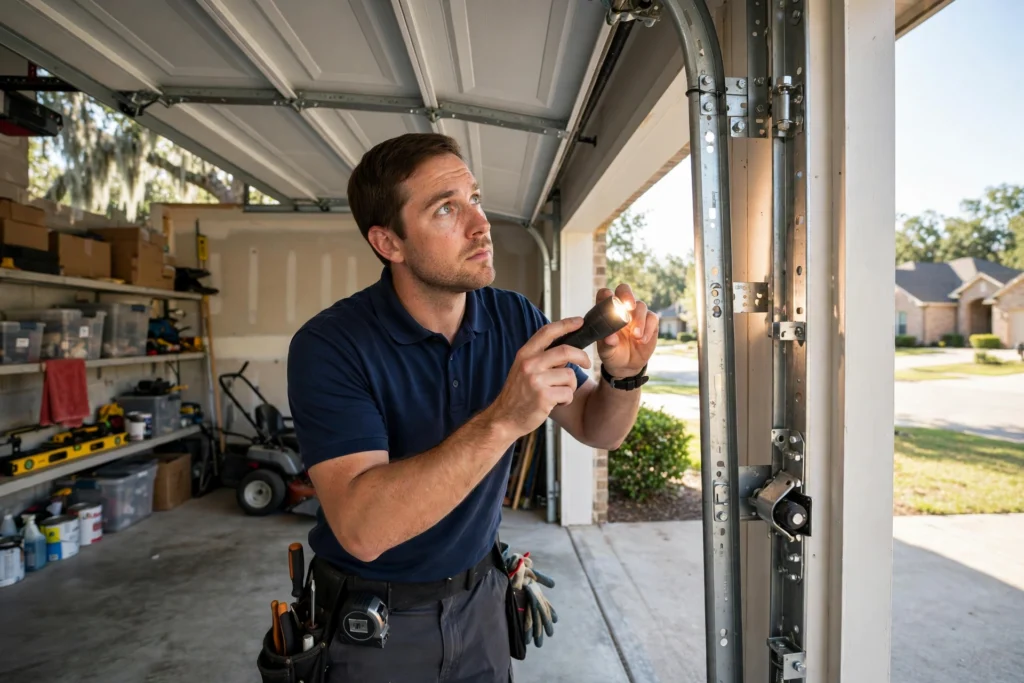
If your garage door has started to sound like it is complaining every time you come home, pay attention, because a noisy door is a door talking to you. A garage door is one of the most honest machines in your house. Long before a part fails, it usually announces the problem out loud, and the sound points almost directly at the part that is wearing out. A squeak is rarely a spring problem. A bang is never a lubrication problem. Learn the difference, and you can tell within one cycle of the door whether you are looking at a quick fix of your own or a call to a technician.
At Garage Door Pros, noisy doors are one of the most common reasons Richardson homeowners call us, and our first question is simple: what does it sound like? This guide walks through the sounds we hear about most, what each one usually means, the checks you can safely run yourself, and the jobs you should never touch. One local note: Richardson summers are hard on garage doors. Heat dries out lubricant faster here, and metal parts expand in the afternoon sun, so a door that ran quietly in April can be genuinely loud by August.
First, Listen: How to Match the Sound to the Problem
Before you buy parts or book a repair, run one slow listening test. Stand inside the garage with the door closed, press the wall button, and let the door run one full cycle up and one full cycle down. Listen for three things: the type of sound, where it comes from, and when in the cycle it happens. A noise from the left track means something different from a noise from the opener motor in the center, and a noise at the start of travel means something different from one at the floor. Here is the quick map:
- Squeaking or squealing that rises and falls as the door moves: almost always dry hinges or rollers asking for lubricant.
- Grinding or scraping, like metal being dragged: worn roller wheels, a failing roller, or the door rubbing against the track or the frame.
- Rattling or clattering, worst when the door starts and stops: loose hardware shaking a little more with every cycle.
- Popping, cracking, or one loud bang: door sections sticking and releasing, a spring under stress, or, in the case of a single sudden bang, a spring that has just broken.
- Humming with no movement: the opener motor is running but the door is not, which points at the opener drive, a disconnected trolley, or a door made too heavy by a failed spring.
Squeaking or Squealing: Usually Dry Hinges and Rollers
The squeak is the most common garage door noise in Richardson, and usually the least serious. Each hinge joining your door sections has a pin that flexes every time the door bends around the curve of the track. Rollers ride in the tracks on small stems, and many have bearings inside the wheel. When the lubricant on those parts dries out, the metal starts to sing. The sound is often worst on the first run of the morning and after hot afternoons.
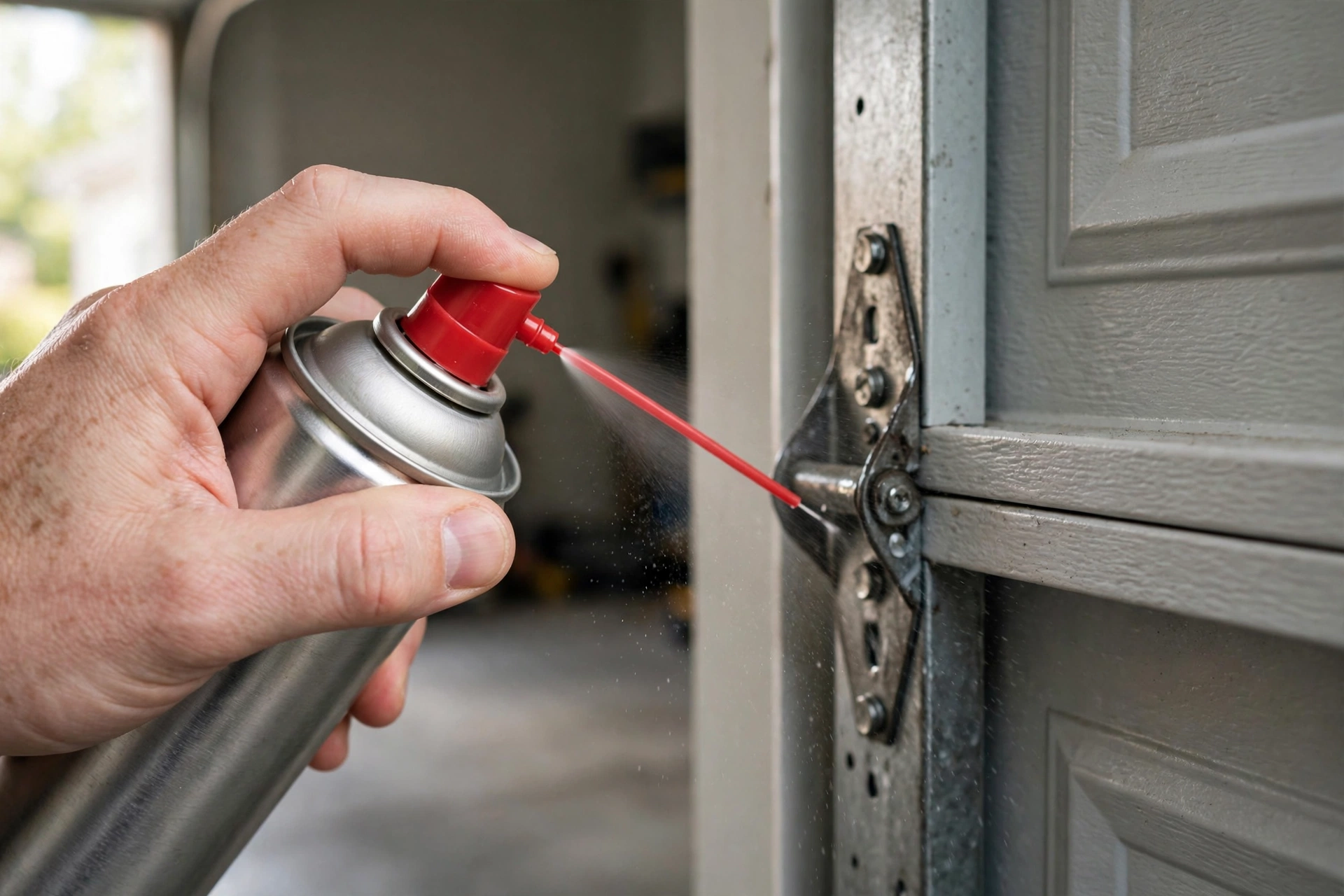
The fix is a can of garage door lubricant, either a silicone spray or a white lithium grease spray made for the job. Put a short spray on each hinge knuckle, on the roller stems, and a light coat along the torsion spring above the door, then run the door through two full cycles to work it in. A door squeaking purely from dryness often goes nearly quiet by the second cycle. Two things to avoid: never grease the tracks, because grease collects grit and makes rollers slide instead of roll; and do not rely on a penetrating oil, which dries out fast and leaves the parts drier than before.
If one spot still squeaks after lubrication, look closely at that hinge and roller while someone else runs the door: a hinge can crack with age, and a roller bearing can wear out completely, and no lubricant fixes a failed bearing. That is when roller and hinge replacement earns its money: fresh rollers with sealed bearings and solid new hinges remove the noise and the wear behind it.
Grinding or Scraping: Worn Rollers or a Track Problem
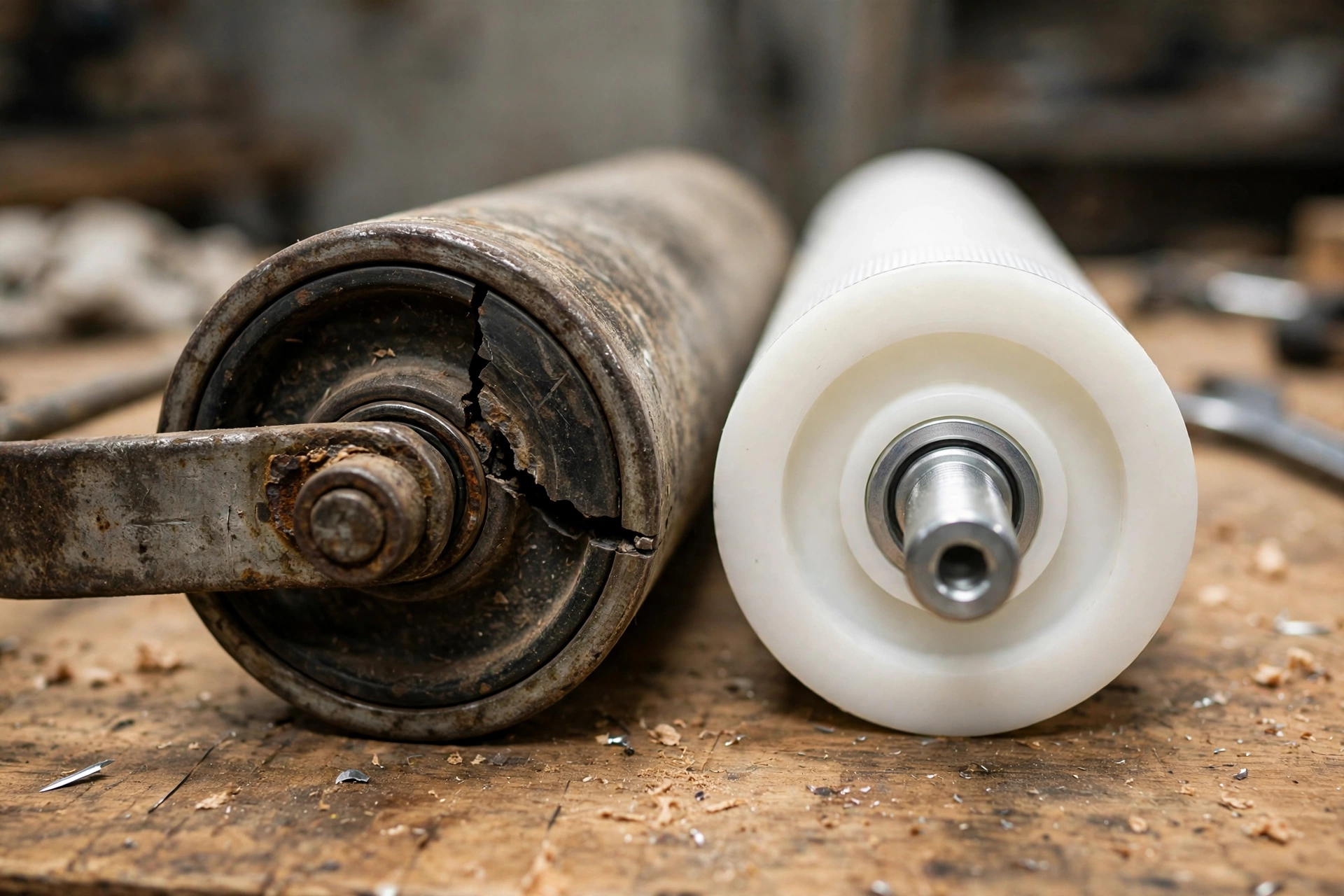
Grinding is the sound of metal being worn away, and it deserves more respect than a squeak. The usual source is the rollers. A healthy roller wheel is round and smooth. A worn steel roller develops flat spots, its bearings loosen, and the wheel starts to wobble in the track instead of rolling cleanly, which produces a gritty, dragging sound that often comes from one side of the door. The other common source is contact: a door that has shifted slightly can scrape the track or the wooden frame as it passes, and a bent track section grinds at the same point in every cycle.
You can inspect this safely, without touching anything under tension. With the door closed, look along each track for shiny rub marks, dents, or a buildup of fine dark dust beneath it, which is metal already ground off. Then watch the rollers during one cycle: a good roller spins smoothly, while a failing one skips, tilts, or drags. If the sound happens at precisely the same door height every time, suspect the track or the frame at that height rather than a moving part.
What you should not do is force the door through a grinding spot, or keep running it for weeks and hope it smooths out. Every cycle with a bad roller chews the track a little more, and a roller that jumps the track can leave the door hanging crooked in the opening. This is a repair, not a spray job: new rollers are one of the best value fixes in this trade, and switching from worn steel rollers to modern nylon rollers removes the grind and quiets the whole door in the same visit. If the track itself is bent, a technician can often straighten it or replace just that section.
Rattling and Vibrating: Loose Hardware Shaking Itself Apart
A rattle is the sound of play in the system. Your door, its tracks, and its opener are held together by dozens of nuts and bolts: hinge bolts on every section, track bolts, and the fittings that mount the opener. Vibration is part of every cycle, and over years of daily use that vibration slowly backs the nuts off. Once one hinge is loose, its section flexes and clatters, and the extra movement loosens its neighbors faster. Rattling is often worst at the moment the door starts and stops, when the whole structure shudders.
We see this constantly on older doors in neighborhoods like Richardson Heights, where plenty of doors have cycled daily for 15 years or more on original hardware. The good news is that tightening hardware is a safe homeowner job, as long as you stay on the right bolts. With the door closed, use a socket wrench to snug the nuts on the hinges and the track brackets, firm but not forced. Then follow one hard rule: never loosen or remove the bottom brackets at the lower corners of the door, where the lift cables attach, and never touch a bolt that is painted red. Those parts connect to the spring system and are under serious tension even with the door closed. Tighten the hinges all you like; leave the bottom corners to a technician.
Popping or Banging: Springs, Cables, and the One Sound That Means Stop
Popping sounds sit on a scale. At the mild end, a pop or crack as the door starts moving can be a section sticking briefly to the weather seal or to the section below it, then releasing. Paint and rubber stick more in Texas heat, so a pop on the first opening of a hot afternoon is often harmless. A spring can also pop as its coils shift against each other, a sign it is dry or aging.
The other end of the scale is the sound every homeowner remembers: a single loud bang, like a gunshot or a heavy book dropped on concrete, often heard from inside the house with nobody near the garage. That is almost always a torsion spring snapping. The spring above the door does the heavy lifting on every cycle, and when it breaks, the stored energy lets go all at once. Afterward the door sits dead. It may not open at all, or the opener may strain and give up, because the opener was never designed to lift the full weight of the door, and a two car door can weigh well over 150 pounds without its spring.
If you hear that bang, treat the door as out of service. Do not keep pressing the opener button, which can burn out the motor or strip its gears. Do not recruit neighbors to help lift the door by hand; without its spring it is a dead weight that can drop. And never try to adjust, wind, or replace a spring or a lift cable yourself. Those parts work under extreme tension, and they are the part of the door that seriously injures people every year. Torsion spring repair and replacement is a professional job: the right spring for your door’s weight, the right winding bars, and a balance test before the technician leaves.
Humming but the Door Won’t Move: Opener Gears and Strain
A hum with no movement means the motor has power and is trying, but the work is not reaching the door. Start with the simple check: someone may have pulled the red emergency release cord, which disconnects the door from the opener’s trolley. If the trolley is disconnected, the motor will hum and the chain or belt will travel while the door sits perfectly still, and reconnecting the trolley is a normal homeowner step. Our guide to a garage door opener not working walks through that check and the rest of the opener checks in the right order.
If the trolley is connected, the likely causes are inside the opener or in the door itself. Many openers drive the chain through a plastic gear, and when that gear strips, the motor hums and nothing moves; fine white plastic shavings inside the unit are the giveaway. The other main cause is strain: if a spring has broken or partly failed, the door becomes far heavier than the opener can handle, and the motor hums against a load it cannot lift.
The Fixes You Can Do Yourself vs. the Ones to Leave Alone
Here is where the line falls. These fixes are safe for most homeowners:
- Lubricate the hinges, roller stems, bearings, and spring with silicone or white lithium spray, about twice a year.
- Tighten hinge and track bracket hardware with a socket wrench, never the bottom brackets and never a red painted bolt.
- Clean the inside of the tracks with a damp cloth so the rollers travel through a clear path.
- Listen once a month, and write down when a new sound starts, while the fix is still small.
And these belong to a technician, every time:
- Springs and cables, whether they look worn, sound wrong, or have already broken.
- Bent tracks and doors that have jumped the track, which have to be realigned while the spring tension is controlled.
- Opener gears and anything inside the motor unit, beyond reconnecting the release cord.
- Any grinding that is still there after lubrication, because that sound means a part is worn out, not dry.
Most noise is simply wear announcing itself early, which is good news if you act on it. A preventative maintenance tune-up covers the whole safe list in one visit: lubrication, hardware tightening, a roller and spring inspection, and a balance and safety check. Homeowners in Heights Park and across Richardson often book one in spring, before the summer heat dries everything out again.
Frequently Asked Questions
Is a noisy garage door dangerous?
The noise itself is not the danger; what it is reporting can be. A squeak from dry hinges is harmless. A rattle means hardware is loosening, which can eventually let a section flex or a roller leave the track. A bang means a spring has broken, and a door with a broken spring can drop if it is forced up. Treat any new, loud, or sudden noise as a reason to stop and look, and treat banging and grinding as reasons to call a technician.
What lubricant should I use on my garage door, and what should I avoid?
Use a silicone spray or a white lithium grease spray made for garage doors, applied to the hinges, roller stems and bearings, and as a light coat on the spring. Avoid heavy grease, which holds grit against moving parts, and avoid relying on a general penetrating oil as your lubricant, because it evaporates within weeks and leaves the parts dry. Never lubricate the tracks themselves; clean them instead, so the rollers roll rather than slide.
How much quieter are nylon rollers than metal rollers?
Noticeably quieter, and it is usually the single biggest noise improvement a door can get. A steel wheel rings and rattles inside a steel track, while a nylon wheel meets the same track with a soft, damped sound and no metal on metal contact. Homeowners who replace a full set often tell us the door went from waking the house to being hard to hear from the next room. Nylon rollers with sealed bearings also hold their lubricant longer, so they stay quiet with less upkeep.
Why is my garage door loud only when it closes (or only when it opens)?
Because the parts work under different forces in each direction. When the door opens, the springs do most of the lifting and the opener pulls. When it closes, the opener pushes and gravity helps, so slack, wear, or a slight bind shows up in a different part of the cycle. A door that pops only at the start of opening may be sticking to its seals, while one that grinds only while closing may be rubbing as the sections settle down. The pattern is a real clue, so note it down for the technician.
When does a noise mean I need a repair instead of lubricant?
When the noise is grinding, banging, or popping from the spring area; when it survives a proper lubrication and is back within days; when it arrives suddenly instead of growing slowly over months; or when it comes with jerky movement, a door that sits crooked, or an opener that strains and stops. Those are wear and failure sounds, not dryness sounds, and no spray fixes a worn bearing, a cracked hinge, or a failing spring.
Ready for a Door That Sounds Like It Should?
If your door is squeaking, you have probably just read about a fix you can finish yourself. If it is grinding, rattling itself loose, or it made a bang you will not forget, that is our side of the list. Call (855) 496-0527 or get a free quote and tell us what the door sounds like; that one detail helps us show up with the right parts on the truck. Garage Door Pros is based at 1407 E Campbell Rd #1000, Richardson, TX 75082, and we quiet noisy doors across the city.