
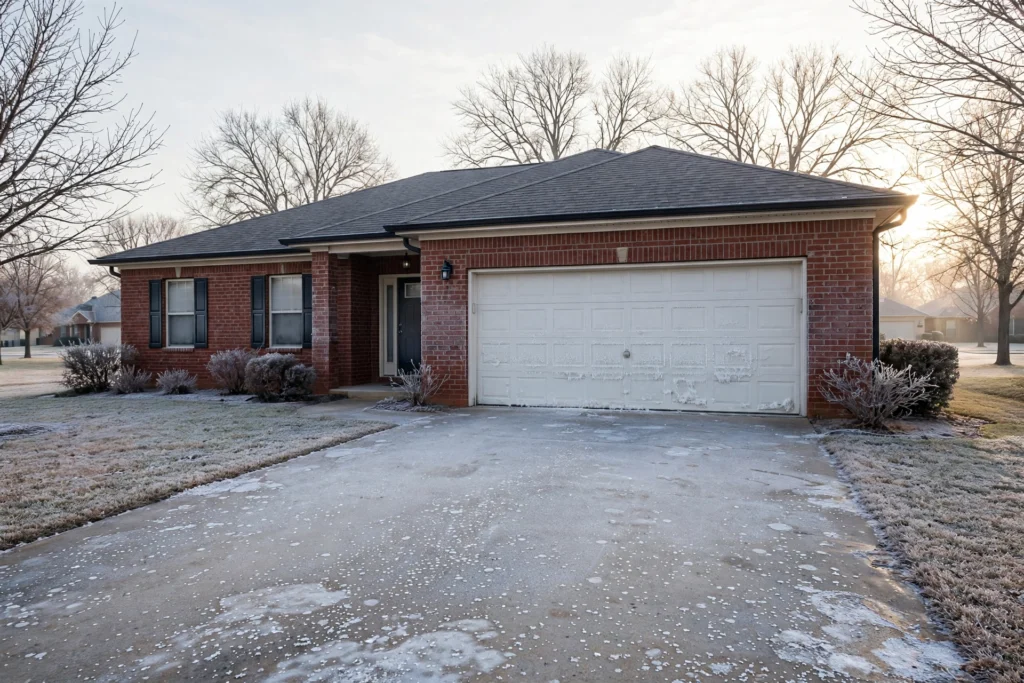
Why Texas Cold Snaps Catch Garage Doors Off Guard
Richardson winters are mild most of the time, and that is exactly the problem. Garages here are built and maintained for heat, not cold, so when a real freeze arrives, it usually lands overnight with very little warning. Anyone who lived here in February 2021 remembers how that goes: temperatures stayed below freezing for days, pipes burst all over North Texas, and garage doors failed in waves. Seals froze to the concrete, springs snapped on the coldest mornings, and openers strained against doors that would not budge. This guide to garage door cold-weather prep in Richardson, TX shows you exactly what to check before the next freeze arrives.
At Garage Door Pros, we see the same pattern in every cold snap, even the short ones. A door that ran fine at 55 degrees refuses to open at 22, because cold changes how every part of the system behaves. The good news is that most freeze failures are predictable, and many are preventable with one mild weekend of prep. An insulated garage door also shrugs off cold snaps better than a thin single-layer door, but even a basic door can get through a hard freeze if the moving parts are ready for it. This guide covers what cold actually does to your door, the pre-freeze checklist, and what to do on the morning the door will not move.
The 5 Things a Freeze Does to Your Door
Cold does not attack a garage door in one way. It attacks in five, all at the same time.
Grease and lubricant go stiff. The lubricant on your rollers, hinges, and springs thickens as temperatures fall, and old, gummy grease gets worse. Parts that glided in October drag in January, the door gets noisy and slow, and the opener has to pull harder on every cycle.
Metal contracts. Steel tracks, hinges, and springs shrink slightly in the cold, and clearances that were fine in the fall can start to bind. A door that was a little out of alignment can rub or stick, and hardware that was already loose works itself looser.
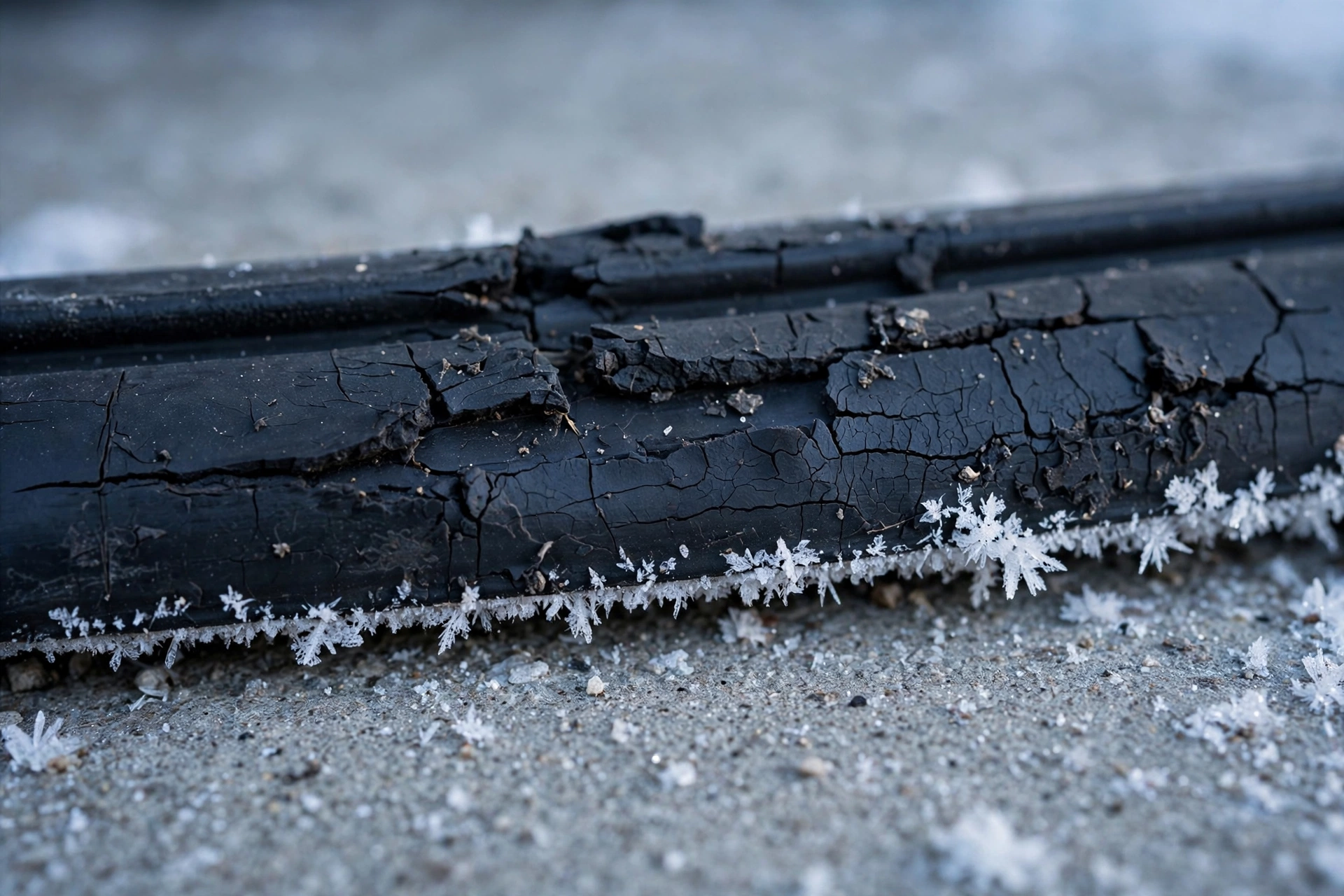
Rubber seals turn brittle. The bottom seal and the weatherstripping around the frame lose their flexibility in the cold. Stiff rubber cracks instead of flexing, gaps open up, and cold air pours in. Worse, moisture trapped under the bottom seal can freeze it solid to the concrete slab.
Batteries fade. Cold drains batteries faster, and remote and keypad batteries are usually the first to go. The classic freeze morning complaint is a remote that worked yesterday and does nothing today, with a car trapped inside behind a door that seems dead.
Springs get brittle at the worst moment. Cold steel is less forgiving than warm steel. A spring that is near the end of its working life still carries the full weight of the door, and the coldest morning of the year is very often the morning it lets go. We come back to this one below, because it is the freeze failure that matters most.
The Pre-Freeze Checklist: What to Do on a Warm Weekend
Pick a mild fall weekend and give the door about an hour. Our garage door maintenance tips cover the year-round routine in full; this checklist is the freeze-specific layer that goes on top of it.
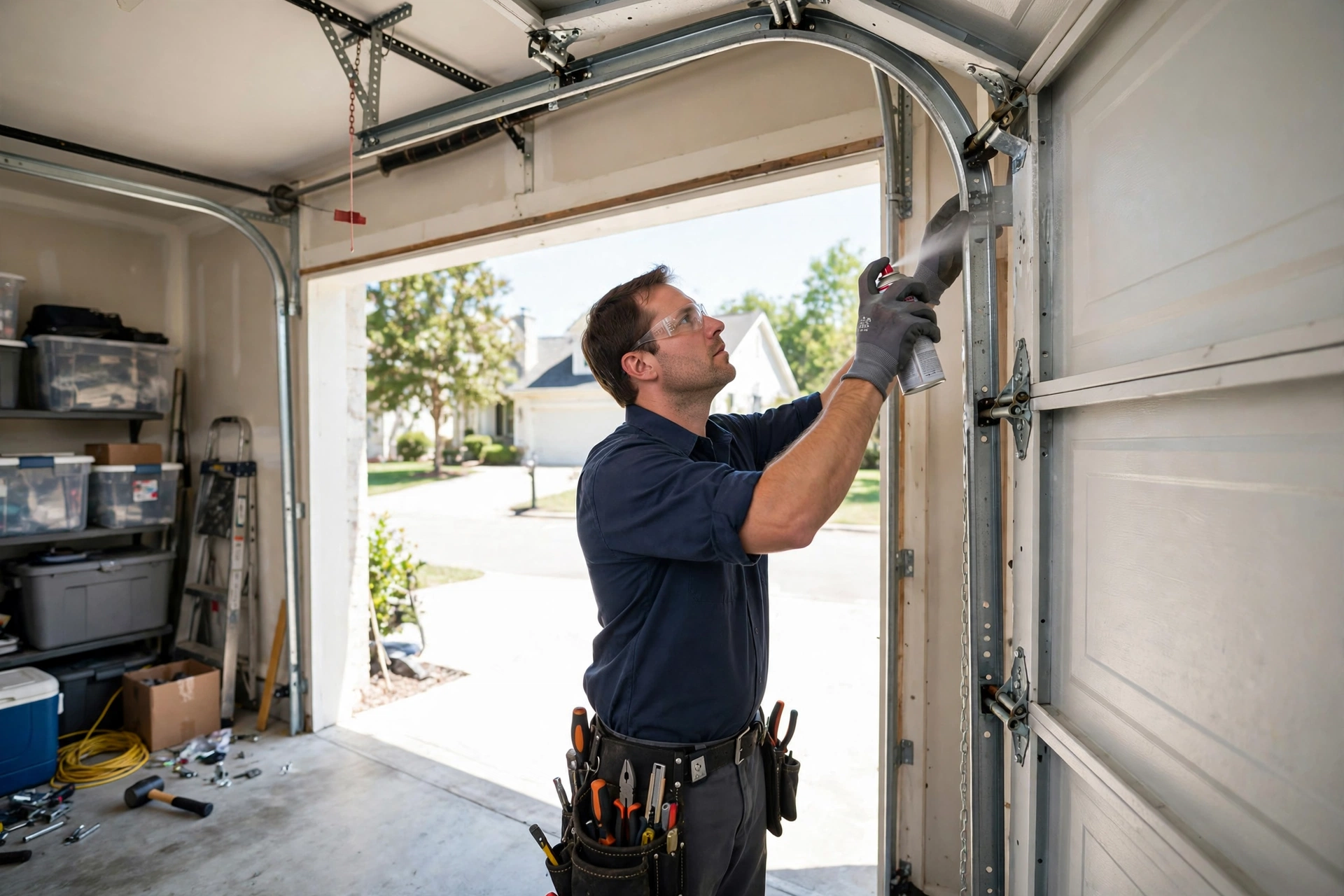
- Lubricate every moving part. Wipe off old, dirty grease first, then apply a silicone or white lithium spray made for garage doors to the rollers, hinges, and springs. Fresh, cold-friendly lubricant is the single biggest difference between a door that drags and a door that glides on a freezing morning.
- Inspect the bottom seal while it is still soft. Look for cracks, flattened spots, and gaps at the corners. A worn seal is cheap to replace in the fall and miserable to deal with once it has turned stiff and brittle in the cold.
- Test the balance. With the door closed, pull the red release cord and lift the door halfway by hand. It should stay roughly where you leave it. A door that feels heavy or drifts down is telling you the springs are tired, and tired springs are the ones that snap in a freeze.
- Run the safety tests. Set an empty box in the doorway and close the door; it should reverse when it touches. Wave a hand through the photo eye beam while the door is closing; it should reverse again. You want to know these work before you are depending on the door in bad weather.
- Swap the batteries now. Fresh batteries in every remote and in the outside keypad take two minutes in October. During a freeze, with a car stuck inside, it is a much bigger errand.
- Clear the tracks and the doorway. Sweep out leaves and grit, and make sure nothing drips water where it can freeze across the threshold. Ice building up in the tracks or along the slab edge is what locks a door down.
- Book a pre-freeze tune-up. A technician checks the things a checklist cannot: frayed cables, worn rollers, spring fatigue, opener strain. A door that passes a tune-up in the fall is a door you can trust in January.
Frozen Shut? How to Free a Door Without Breaking It
The morning it happens, the script is almost always the same: you press the remote, the opener hums and strains, and the door moves an inch or does not move at all. In most cases the bottom seal has frozen to the slab, or ice has locked the tracks. The door itself is usually fine. Your opener is the thing in danger.
Rule one is to stop pressing the button. One attempt tells you the door is stuck. Cycling the opener again and again against a frozen door can strip the opener’s gear, burn out the motor, or put enough strain on a cold spring to snap it. Force is how a free fix turns into two repairs.
Instead, work through it by hand. Pull the red release cord with the door fully down to disconnect the opener, then try lifting the door manually with steady, even pressure. If the seal is frozen to the floor, pour warm water, never boiling, slowly along the bottom edge of the door, inside and out, to melt the bond loose. Work any ice out of the tracks with a plastic scraper rather than a metal tool that can gouge them. Once the door lifts freely, dry the bottom seal and the strip of concrete it rests on so the bond does not simply form again, then reconnect the opener and run one full cycle.
If the door still will not lift by hand, something mechanical has failed, and that is not an ice problem anymore. The same goes if you heard a loud bang, or the door sits crooked. That is the moment to call for emergency garage door repair instead of reaching for more force.
The Spring Warning: Why Springs Snap on the Coldest Morning
Ask any garage door technician in Richardson and they will tell you the same thing: the phone starts ringing early on the coldest morning of the year, and most of the calls are broken springs. It is not bad luck. A torsion spring is rated for a set number of open and close cycles, and it spends them one at a time, all year. Cold makes the steel less flexible, contraction adds a little extra tension, and a spring that is already near the end of its life meets the hardest conditions of the year at the exact moment it has the least left to give.
The warning signs are usually there weeks before the snap. Our guide to the warning signs of a broken garage door spring walks through them: a visible gap in the coil, heavy rust, a door that has started to feel heavier, or one that lifts unevenly. The cold does not cause those problems. It just collects on them.
If a spring does let go, treat the door as completely out of service. A door with a broken spring is dead weight, far too heavy to lift safely, and running the opener against it only adds an opener repair to the bill. Spring work is also the one job in this trade that should never be a do-it-yourself project, because a wound spring holds enough stored energy to cause serious injury. Torsion spring repair and replacement is professional work, and during a freeze it is the first call to make.
What to Keep in the Garage Before the Next Freeze (And What to Move Inside)
The garage is where a freeze does its quiet damage, and it is worth thinking about what is stored out there before the cold arrives. In neighborhoods like Canyon Creek and Richardson Heights, plenty of homes have plumbing running through garage walls or a water heater sitting in the garage, and those pipes are often the first freeze risk in the whole house.
- Move inside or protect: Potted plants are the obvious one, since an unheated garage can drop below freezing even while the house stays warm. Paint, finishes, and anything water-based can be ruined by one hard freeze. Disconnect garden hoses, and bring in anything that holds water, like a pressure washer, so it does not crack from the inside.
- Protect in place: Wrap any exposed pipes you can reach, and make sure everyone in the house knows where the main water shutoff is before they need it at midnight. Keep the garage door itself closed during the snap; every minute it stands open dumps the little warmth the space had.
- Keep by the door: A flashlight that works, a bag of sand or cat litter for traction on an icy driveway slope, and a plastic ice scraper. If your door has been struggling, consider parking the car outside the night before a forecast hard freeze, so a frozen door cannot trap it.
- One safety rule: Never run a car, generator, or space heater with a flame inside a closed garage to warm things up. Carbon monoxide builds up fast in that enclosed space. Warm the door with warm water and patience, not with an engine.
When the Door Still Won’t Open: Fast Help in Richardson
Some freeze failures are not checklist problems. A snapped spring, a cable that lets go under the strain, an opener that burned itself out fighting a frozen door, or a door that sits crooked in its tracks all need a technician, not a space heater and hope. If the door is hanging unevenly, will not move in either direction, or a spring shows a visible gap, leave it alone and keep everyone clear of it.
A door stuck open during a freeze counts as urgent too, since it leaves the house exposed to the cold and everything in the garage unprotected. Those are the mornings our emergency garage door repair team is built for, and they are far easier to prevent than to fix, which is the whole point of the checklist above.
Frequently Asked Questions
Why won’t my garage door open on cold mornings but works fine later?
Overnight, lubricant thickens, metal contracts, and the bottom seal stiffens, so the door is at its hardest to move first thing in the morning. As the day warms up, the parts loosen and the door frees itself. If it happens once during an extreme snap, it may just be the weather. If it happens on every cold morning, the lubricant is old or the parts are worn, and a tune-up with fresh lubricant usually ends the pattern.
Can a garage door freeze shut, and how do I open it safely?
Yes. Moisture under the bottom seal freezes it to the concrete, and ice in the tracks can lock the door in place. Disconnect the opener with the release cord, pour warm water along the bottom seal to melt the bond, clear ice from the tracks with a plastic scraper, and lift the door by hand. Never keep cycling the opener against a frozen door, and never try to force it with a vehicle or a pry bar, which can bend panels and snap springs.
Should I change my opener’s force settings in winter?
No. Turning the force up so the opener can overpower cold stiffness hides the real problem and can damage the door, the opener, and the safety systems that depend on those settings. Fix the friction instead: fresh lubricant, a healthy seal, and a properly balanced door. If the opener still cannot lift a balanced door after that, the opener itself needs service.
Do garage door springs really break more often in cold weather?
Yes, it is one of the most consistent patterns in this trade. Cold makes spring steel less flexible, contraction adds tension, and springs that are already near the end of their cycle life are the first to fail, usually on the coldest morning of the season. Because a wound spring stores a great deal of energy, replacement is a professional job, not a weekend project.
What should I do before a freeze if my door is already noisy or slow?
Treat the noise and slowness as a warning, not a quirk. Lubricate the moving parts, test the balance, and check the bottom seal. If the door is still noisy or slow after that, book a tune-up before the freeze arrives, because a marginal door in the fall is very often a stuck door in January. Catching a tired spring or a frayed cable early is far cheaper than an emergency call during a cold snap.
Get Your Door Ready Before the Temperatures Drop
A Texas freeze never gives much notice, but your garage door does not have to be caught off guard by one. Call (855) 496-0527 to book a pre-freeze tune-up, or get a free quote and tell us how your door has been behaving. Garage Door Pros is based at 1407 E Campbell Rd #1000, Richardson, TX 75082, and we help Richardson homeowners get their doors ready for whatever the winter brings.